60-Second Summary
RB2B remains a strong option for US-focused teams, but teams scaling internationally or seeking greater automation now have better alternatives. The right choice depends on your target markets, the depth of data required, CRM/marketing integrations, and a pricing model that scales predictably.
Key takeaway: Align platform choice to geography, data quality, and integrations—clear, predictable pricing and fewer manual workflows drive long‑term value. Focus on qualified, actionable leads over raw name volume.
Standout strategies: Prioritise GDPR‑aware providers for global reach, ensure two‑way CRM sync, field mapping and automation triggers, and combine visitor ID + intent + enrichment to connect marketing activity to pipeline.
Real‑world lesson: Use visitor insights for revenue attribution, competitive intelligence, and personalised outreach—example: Coveris used Leadfeeder to triple prospecting efficiency, halve research time, and double meetings with qualified leads.
Selection framework: Evaluate geography, existing tech stack, sales process needs (enrichment, ABM, real‑time alerts), and pricing model—Leadfeeder stands out for global/GDPR use cases, while other tools fit niche needs like enterprise scale or outbound affordability.
*This summary was created with AI assistance, using our original content.
RB2B can still work well for US-focused teams. But for businesses scaling internationally or seeking greater flexibility and automation, stronger options now exist. The right choice ultimately depends on a few key factors: where your target market is, the quality and depth of data you need, how well the platform integrates with your CRM and marketing tools, and whether its pricing model can scale with your growth.
Today, as teams become increasingly tech-reliant, your sales and marketing tools need to work seamlessly together rather than create more manual work. At the same time, pricing should be clear and predictable. Look for platforms that offer transparency, and consider what your total cost will realistically look like over a typical month or quarter. And remember: the cheapest option isn’t always the best. True value comes from how many qualified, actionable leads you can add to your pipeline, not just how many names appear on your dashboard.
In this guide, we’ll break down:
The top 10 RB2B alternatives in 2026
What each tool is best at (and where it falls short)
Turn page views into pipeline
Identify anonymous companies visiting your website and automatically send them to your CRM for sales teams to convert.
Discover Leadfeeder1. Leadfeeder - Best for Global B2B Teams
Leadfeeder is a pipeline generation platform that combines real-time website visitor identification with powerful intent data, sales intelligence, and GDPR-safe contact enrichment - all built with European data privacy in mind. Unlike RB2B, which is limited to the US market, Leadfeeder’s platform covers global traffic and includes tools for prioritising ICP-fit accounts, automating outreach, and integrating seamlessly with your CRM or marketing stack.
Why it stands out: Combines visitor identification, intent data, and GDPR-compliant enrichment in one platform.
Best for: International sales and marketing teams
Strengths:
Global visitor tracking (not US-only)
Intent signals across channels
Strong CRM integrations
Built-in GDPR compliance
Limitation: Slightly weaker US depth vs some competitors
Pricing: Custom based on company size and usage making it accessible for all companies
2. Factors.ai - Best for Marketing Attribution
Factors focuses on helping marketers understand what’s working. It connects web visitor data with campaign attribution, so you can measure how ads, content, and landing pages influence the pipeline; a smart choice for growth teams with longer sales cycles.
Best for: Growth and demand generation teams
Strengths:
Cross-channel visitor tracking
Campaign attribution and ROI measurement
LinkedIn ad optimisation and integrations
Visual workflow builder for automation
Limitation: Requires additional tools for contact enrichment
Pricing: Starts at $549/month
3. ZoomInfo - Best Enterprise for Data Scale
ZoomInfo is a heavyweight in the data intelligence space, offering vast contact databases and enterprise-grade enrichment. If you need volume, coverage, and buying signals in one place, it’s a strong option, especially in the US.
Best for: Large enterprise sales teams
Strengths:
Massive contact database
Strong US coverage
Advanced enrichment
Limitations:
High cost
Mixed GDPR compliance
Less suited for global-first teams
Pricing: Custom enterprise packages
4. Apollo.io - Best for Outbound Sales Teams
Apollo.io combines lead generation, email sequencing, and enrichment in one affordable package. Its Chrome extension makes LinkedIn prospecting easy, and the free plan is generous enough to test with small teams.
Best for: Startups and SMBs
Strengths:
Affordable pricing
Email sequencing + data in one
Chrome extension for prospecting
Limitation: Weak visitor identification capabilities
Pricing: Free plan available; paid plans from $49/month
5. Lusha - Best for Contact Accuracy
Lusha makes it simple to find accurate B2B contact data. As a tool it’s particularly useful for SDRs doing one-to-one prospecting. Its emphasis is on phone numbers and real-time verification, helping teams avoid bad data.
Best for: SDRs doing direct outreach
Strengthss:
Real-time contact verification
Browser extension
AI-powered outreach templates
GDPR compliance support
Limitation: No visitor tracking or intent data
Pricing: Free, limited version available; Pro version starting at $22 per month with annual billing
6. Cognism - Best for GDPR-Compliant Prospecting
Cognism is known for its compliant approach to data across Europe. With strong coverage in the UK, DACH, and other regions, it’s become a go-to choice for GDPR-conscious sales teams.
Best for: Teams selling into European markets
Strengths:
Global contact data
GDPR-compliant processes
Sales trigger alerts
European market coverage
Limitation: Limited visitor tracking
Pricing: Custom based on usage
7. 6sense - Best for Predictive ABM
6sense takes a predictive approach, using AI to identify which accounts are most likely to buy based on behaviour and signals. It’s an enterprise-level tool aimed at mature ABM programs with deep marketing and sales alignment.
Best for: Large-scale ABM programs with complex sales cycles
Strengths:
Intent data analysis
Account-based marketing tools
Predictive analytics
Anonymous visitor tracking
Limitations:
Complex setup
Expensive
Pricing: Enterprise-level, custom
Limitations? Setup is complex, onboarding takes time, and pricing is high. It’s overkill for smaller teams or those just getting started with ABM.
8. RollWorks - Best for Account-Based Advertising
RollWorks blends account-based marketing and advertising, enabling teams to serve targeted ads to high-fit accounts using IP data. It integrates tightly with Salesforce and other tools for easy campaign orchestration.
Best for: B2B marketing teams focused on awareness and retargeting
Strengths:
IP-based ad targeting
CRM integration
Account scoring
Campaign measurement
Limitation: Limited sales intelligence depth
Pricing: Tiered plans available
9. Demandbase - Best All-in-One ABM Platform
Demandbase offers an all-in-one suite for account-based advertising, website personalisation, and sales intelligence. It’s built for enterprise teams with the budget and resources to run sophisticated, multi-touch campaigns.
Best for: Mature marketing orgs with large-scale ABM goals
Strengths:
Website personalization
Intent data tracking
Account-based advertising
Sales intelligence
Limitations:
High cost
Steep learning curve
Pricing: Custom based on modules
10. Warmly - Best for Real-Time Engagement
Warmly turns anonymous website visitors into leads, then helps you act on them. It’s one of the few tools with built-in live video calling, which can be powerful for B2B teams doing high-touch sales.
Best for: B2B sales teams wanting immediate engagement with website visitors
Strengths:
AI-powered visitor identification
Automated outreach via email and LinkedIn
Live video calling capabilities
Integration with popular CRMs
Limitation: Inconsistent identification coverage
Pricing: Free plan available; Data Agent plan starting at $900 per month
RB2B Alternatives Comparison (2026)
Key Features to Compare among RB2B Competitors
When evaluating RB2B competitors, these key features help determine which platform best fits your needs:
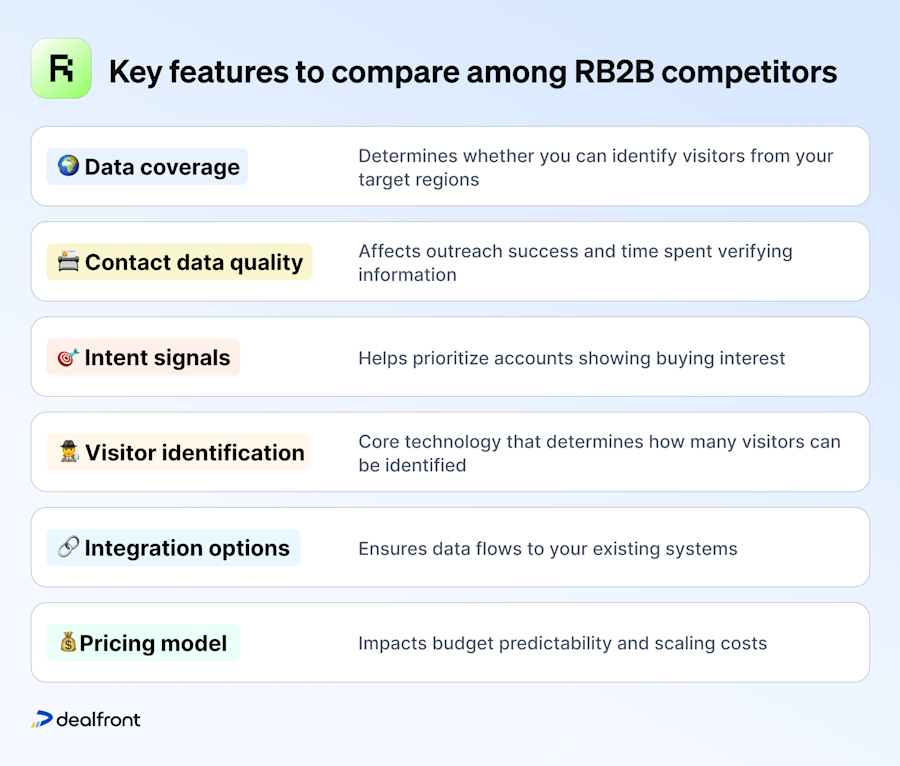
The most effective platform for you will depend on your specific business goals, target market, and existing tech stack. A solution that works perfectly for one company might be less effective for another with different needs.
Integration and Compliance Considerations
Beyond core features like visitor identification and intent data, long-term success with any RB2B platform hinges on how well it integrates with your existing systems and handles compliance.
1. CRM connections
How data moves between your visitor identification platform and CRM can make or break your team's efficiency. Manual data entry leads to errors, delays, and missed opportunities. The best performing platforms offer seamless integration that enables smooth, automated workflows. Look out for:
Two-way sync:ensures that updates in either your CRM or your RB2B platform are reflected in both systems, keeping your contact and account data accurate and up to date.
Field mapping: gives you control over which fields from your RB2B tool push into your CRM (and vice versa), so you’re not overwhelmed with irrelevant data.
Automation triggers: enable actions in one system, such as a website visit or an intent spike, to automatically trigger workflows in your CRM or marketing automation platform (e.g., lead scoring, notifications, outreach sequences).
When these elements are set up correctly, your team saves time and can act on insights faster, with greater confidence in the data behind their decisions.
2. Privacy compliance
As data privacy laws continue to evolve, across Europe (GDPR), the US (CCPA/CPRA), and beyond, compliance is no longer optional. It's essential. Mishandling personal data not only damages brand trust but also carries significant legal and financial consequences.
Look for a platform that builds privacy into the foundation of their products. Key areas to evaluate:
Consent management: Does the platform track visitor consent in a transparent, auditable way? Can you prove that data collection complies with local laws?
Data storage policies: Where is data hosted? How long is it retained? This matters especially for companies with strict internal policies or regulatory requirements tied to geography or industry.
Certifications and documentation: Look for clear, up-to-date documentation, including compliance with ISO 27001, SOC 2, or other recognised standards. Having this on hand helps your legal and procurement teams move faster during onboarding.
Platforms like Leadfeederstand out here, offering built-in GDPR compliance, data hosting within the EU, and transparent data policies, making them a particularly strong choice for businesses operating in Europe or selling globally.
How Visitor Identification Tools Drive Revenue
Visitor identification tools are often viewed as lead generation software, but the best platforms deliver far more value. When used effectively, they help connect marketing activity to revenue, improve sales efficiency, and strengthen overall go-to-market strategy.
Here are some of the most impactful benefits:
1. Revenue attribution
Track how anonymous website visits translate into pipeline and closed deals. This allows teams to measure marketing ROI more accurately, justify budget allocation, and optimize high-performing channels.
2. Competitive intelligence
Identify when competitors visit key pages such as pricing, product comparisons, or case studies. These signals can inform sales timing, positioning, and messaging.
3. Content performance insights
Understand which blog posts, landing pages, or gated assets attract your ideal customer profile (ICP). These insights help refine content strategy and focus efforts on what drives engagement and conversions.
4. Sales efficiency and personalization
Provide sales teams with visibility into buyer behavior—what pages prospects viewed, how long they stayed, and which campaigns drove their visit. This enables more relevant outreach and reduces time spent on manual research.
Example: Turning Insights into Pipeline
Coveris, a European packaging company, used Leadfeeder to improve its prospecting performance. With better visibility into website visitors and buying signals, the team was able to identify 99% of target companies and reach the right decision-maker up to 80% of the time. They also reduced research time by 75 percent, allowing faster engagement with high-value prospects.
By acting on real-time visitor insights, such as when target accounts viewed key pages, Coveris refined its outreach strategy. The result was a threefold increase in prospecting efficiency and a doubling of meetings with qualified leads, alongside greater confidence in their data.
Finding the Right Solution for Your Needs
We’ve explored what RB2B offers, where it falls short, and which alternatives are best equipped to meet a variety of business needs. Each tool highlighted in this guide brings a unique mix of strengths, from broader data coverage to smoother integrations and better pricing transparency.
Ultimately, the best choice depends on your situation. Consider:
Geography: Where are your key markets? If you’re selling into Europe or globally, you’ll need more than US-only data.
Tech stack: What CRM, marketing automation, and sales tools are you already using? The right solution should integrate smoothly into your existing systems.
Sales process: Do your reps need enrichment, intent signals, ABM features, or real-time alerts? Pick a platform that complements, not complicates, your workflow.
Budget: Do you need a flexible, usage-based model or a predictable subscription? Pricing structure can impact long-term adoption and ROI.
Leadfeeder stands out as a top choice for companies looking to go beyond RB2B. It combines real-time visitor insights, intent data, and sales intelligence, with full GDPR compliance and strong integrations, especially for European and global go-to-market teams.
As you evaluate platforms, don’t just compare checklists. Look at how each one supports your team’s real-world goals. The best solution will be the one that fits naturally into how you already work and helps you work smarter.
FAQs about RB2B competitors
Which RB2B alternative works best for identifying international website visitors?
ZoomInfo and Leadfeeder provide strong global data coverage. ZoomInfo offers access to a broad international database, while Leadfeeder specializes in GDPR-compliant European data with growing global reach.
How long does implementation typically take for these visitor identification platforms?
Implementation usually takes between 2 to 4 weeks. The timeline depends on factors such as platform complexity, required integrations, team size, and internal technical resources.
What pricing models do most RB2B competitors use?
Common pricing models include subscription-based (monthly or annual), credit-based (paying per lead), and per-user licensing. Subscription pricing is often more predictable, while credit-based can scale with usage. Custom pricing models generally offer the best value for money as they can be tailored to your specific needs and goals.
Do these RB2B alternatives offer free trials or demos?
Yes, most RB2B competitors offer either a free trial or a free demo. Warmly, Apollo.io, and Leadfeeder provide demo access, while Apollo.io and Lusha also offer free plans which have limited features.
What is the difference between RB2B and traditional lead generation tools?
RB2B platforms focus on identifying anonymous website visitors and connecting their behavior to intent signals, while traditional lead generation tools rely more on static contact lists or form submissions. Like many of their competitors, RB2B tools give you earlier signals in the buyer journey.
Is visitor identification legal under GDPR and other data privacy laws?
Yes, but only if platforms follow compliance requirements. Tools like Leadfeeder are fully GDPR-compliant and include consent management, data residency controls, and privacy documentation.
Can visitor identification tools work with Google Analytics or other tracking tools?
Many platforms integrate with Google Analytics, CRM systems, and marketing automation tools. Some also pull in UTMs, campaigns, and session data to show full-funnel attribution.
Which RB2B platform is best for small or growing teams?
Leadfeeder, Apollo.io and Lusha are great for smaller teams due to their flexible pricing, easy onboarding, and free plan options. For small European teams, Leadfeeder also offers GDPR-compliant data and scalable integrations.
How do intent signals work in visitor identification platforms?
Intent signals track behaviors like page visits, content downloads, repeat sessions, or account-level research. Tools like Leadfeeder and 6sense analyze these signals to highlight accounts most likely to convert.
Can I use these tools for account-based marketing (ABM)?
Yes. Platforms like Leadfeeder, 6sense, and RollWorks are specifically designed to support ABM strategies by combining firmographic filters, intent data, and personalized outreach workflows.
Disclosure: This comparison was researched and published by Leadfeeder, a product of Dealfront Group GmbH. As a competitor in this space, we have a commercial interest in this topic and have aimed to present an objective, balanced analysis. All third party competitor pricing, features, and claims reflect publicly available information at the time of writing. Product details change frequently. We encourage you to confirm current information directly with each provider before making a purchasing decision. Trademarks and brand names referenced in this article belong to their respective owners and are used solely for identification.

Director of Product Marketing @ Leadfeeder
Bernardo Véstia is Director of Product Marketing at Leadfeeder, where he leads product positioning, messaging, and go-to-market strategy for the platform. With more than 15 years of experience across SaaS, edtech, ecommerce, and travel technology, he specializes in translating complex products into clear market positioning and differentiated value propositions.
Bernardo has led product marketing, growth, and acquisition initiatives across global markets, working closely with product, sales, and marketing teams to define competitive positioning and market strategy. His experience evaluating marketing technology and shaping product narratives informs his perspective on how B2B teams assess tools, understand platform capabilities, and choose the right solutions for their go-to-market stack.