
60-Second Summary
Albacross identifies anonymous website visitors and helps with ABM, lead enrichment, and on-site personalization, but teams often run into limits around cost, integrations, coverage, and deeper analytics. This summary highlights why companies switch and how to choose an alternative that drives pipeline rather than just tracking traffic.
Key takeaways: Many teams move off Albacross because pricing doesn’t scale, CRM/MAP syncing is weak, regional data coverage is limited, and advanced intent/analytics are missing; alternatives range from affordable, pipeline-focused tools (Leadfeeder, Snitcher) to enterprise suites (ZoomInfo, 6sense).
Standout strategies & tactics: Prioritise platforms that combine accurate visitor ID, intent signals, and seamless CRM/MAP integrations; run tests on your own traffic, enable real-time alerts and ICP matching, and choose tools that push insights into workflows rather than siloed dashboards.
Real-world lessons & frameworks: Match tool choice to use case (sales follow-up vs mature ABM), account for hidden costs (setup, training, integrations), and measure success with clear KPIs like identification rates, qualified leads, and pipeline influence.
Quick decision checklist: Verify data accuracy, evaluate intent signal quality, confirm CRM/MAP integrations and privacy compliance, check regional coverage and cost scalability, and ensure onboarding/support to hit adoption targets.
*This summary was created with AI assistance, using our original content.
Albacross is one of the well-known names in this space. Any Albacross review starts with the same basics: it identifies anonymous website visitors and provides insights into their intent and behavior. Many organizations use it to support account-based marketing campaigns, enrich lead generation, and even personalize on-site experiences.But as teams scale, many start to hit limitations.
Common reasons for switching include:
Cost: Albacross pricing may not scale well for smaller teams
Integrations: Weak syncing with CRM/MAP tools creates friction
Data coverage: Limited visibility across regions or industries
Feature gaps: Lack of deeper analytics or actionable intent signals
As Jamie Pagan, Director of Brand and Content at Leadfeeder says: “If your platform can’t help you see which campaigns are driving real pipeline, then it’s not really helping you.” That’s exactly why organizations broaden their search - to find a solution that doesn’t just track visitors, but helps build revenue momentum.
In this guide, we’ll break down how each Albacross alternative compares so you can choose the right platform for your team.
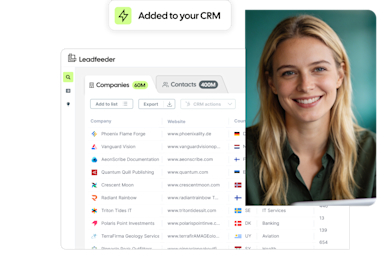
Discover accounts that are ready to buy
Prioritize your outreach when you notice buying signals from your prospects and expand your target list using machine learning.
Learn how to boost your sales1. Leadfeeder
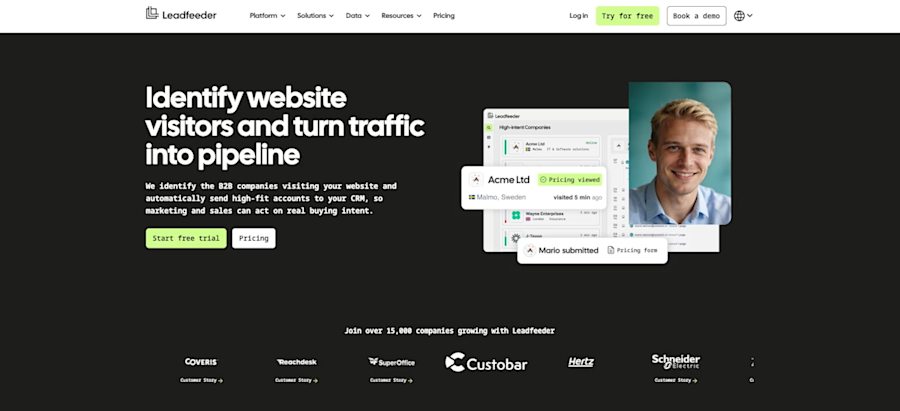
Leadfeeder works to reveal which companies visit your website and how they interact with your content. It uses its own tracking, with Google Analytics as an optional outbound connector, to give revenue teams a clear, always-up-to-date view of buying intent and engagement.
Best for: Balanced accuracy, affordability, and pipeline visibility
Key features:
Powered by its own tracking (but can use Google Analytics as an outbound connector) to enhance tracking and reveal which companies visit your website
Frequently refreshed data for accurate, up-to-date insights
Real-time alerts when target accounts engage with your site
Customisable email digests tailored for Sales and Marketing teams
50+ native integrations with leading tools including HubSpot, Salesforce, and Pipedrive
Flexible plans, including a free option for small teams and paid plans from €79 per month
Challenges:
Free plan has limited data visibility compared to paid tiers
Company data coverage is strongest in Europe rather than the US
Unlike many competitors, Leadfeeder balances affordability with accuracy, making it accessible for small teams but powerful enough for enterprise-scale revenue operations. When combined with Leadfeeder’s wider platform, it becomes more than visitor tracking, and it’s a full pipeline generation engine.
2. Lead Forensics
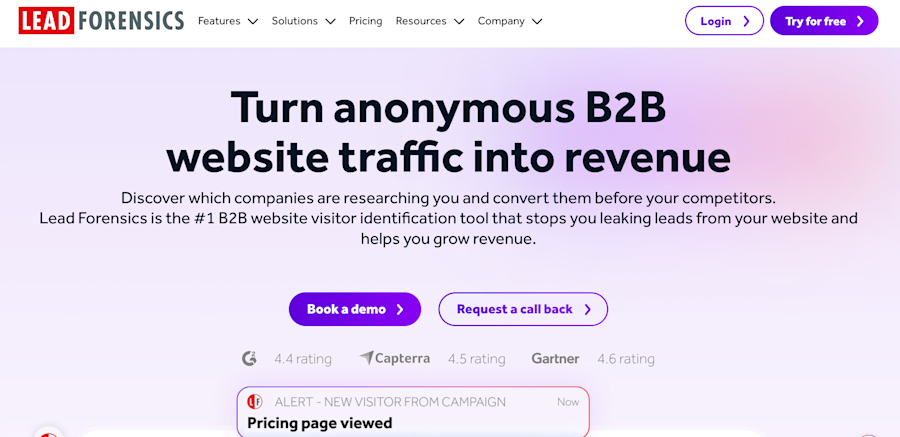
Lead Forensics provides real-time identification of website visitors and detailed browsing behaviour, making it popular among B2B sales teams that want instant alerts.
Best for: Sales teams needing immediate follow-up
Key features:
Real-time company identification
Detailed visitor journey tracking
Lead scoring to prioritise prospects
CRM integrations (Salesforce, HubSpot, etc.)
Challenges:
Primarily built for Sales workflows so less Marketing focus
Pricing is opaque (custom quotes only, annual contracts) and often higher than alternatives; third-party data puts deals from roughly $6,000/year to $95,000/year, with a median around $17,500/year
Steeper learning curve for smaller teams
While powerful for immediate Sales follow-up, its narrower focus and higher pricing may leave Marketing and RevOps teams looking for a more balanced solution.
3. Clearbit (now HubSpot Breeze Intelligence)
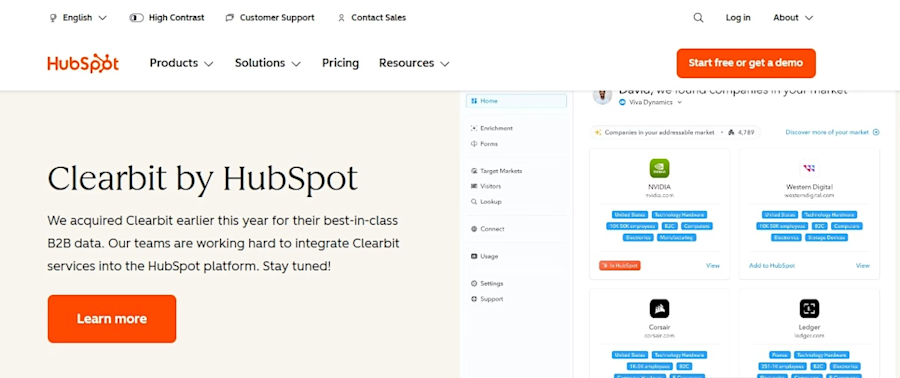
Clearbit is now HubSpot Breeze Intelligence. HubSpot acquired Clearbit and folded it into its platform, and standalone Clearbit (including its free tools) was retired by April 2025. It now runs as a data-enrichment and buyer-intent layer inside HubSpot rather than an independent product. If Clearbit is on your shortlist, our Leadfeeder and Clearbit comparison is the quicker way to weigh the two up.
Best for: HubSpot customers who want enrichment and intent built in
Key features:
Real-time company and contact enrichment inside HubSpot
Buyer-intent signals and form shortening
Native to the HubSpot CRM and marketing tools
Challenges:
Requires a paid HubSpot subscription; no longer available as a standalone tool
Visitor identification was never its core strength; it is an enrichment layer
Value is tied to the HubSpot ecosystem
Breeze Intelligence suits teams already invested in HubSpot. The add-on starts at $45/month (billed annually) for 100 enrichment credits, on top of a paid HubSpot plan.
4. Leadinfo
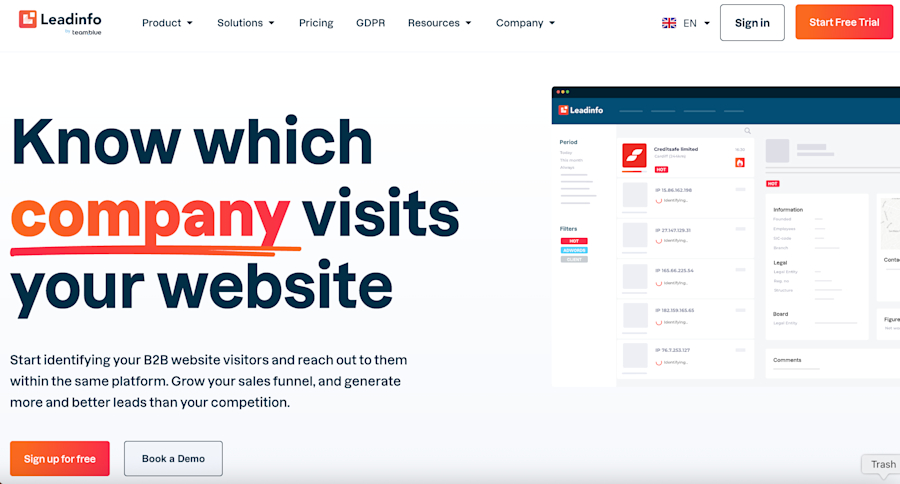
Leadinfo offers a simple, user-friendly interface with strong European data coverage. It’s designed for teams that may not have technical backgrounds but want to easily understand who’s visiting their site.
Best for: SMEs in Europe
Key features:
Intuitive inbox-style interface for visitor identification
Over 60 integrations, including popular CRMs and marketing tools
Lead capture forms built into the platform
Free trial and flexible pricing based on the number of identified companies per month
Challenges:
Coverage is strongest in Europe, less comprehensive globally
Simpler analytics may limit enterprise use cases
Lacks advanced intent modelling compared to bigger platforms
Leadinfo is a strong option for SMEs in Europe but may not scale as effectively for global revenue teams.
5. ZoomInfo Sales
ZoomInfo Sales maintains one of the largest B2B databases on the market and delivers visitor insights alongside extensive contact data, making it a heavyweight for enterprise prospecting.
Best for: Large teams with complex prospecting needs
Key features:
Extensive company and contact search
Intent signals layered onto visitor tracking
Segmentation tools for ABM campaigns
Enterprise-level integrations with CRMs and MAPs
Challenges:
Premium pricing, often suited only for large organisations
Steeper adoption curve; smaller teams may underuse its depth
Visitor tracking is one of many features, not its core focus
ZoomInfo’s breadth is, arguably, unmatched, but for many teams, the complexity and cost outweigh the benefits if visitor tracking is their main goal.
6. 6sense Revenue Marketing
6sense is built for advanced account-based marketing programs, offering predictive analytics that give deep insights into buyer behaviour and engagement.
Best for: Mature ABM teams
Key features:
Predictive analytics to forecast buyer readiness
Account scoring and prioritisation
Deep ABM campaign analytics
Workflow automation for Marketing teams
Challenges:
Complex to implement, requires sophisticated RevOps support
A free plan exists, but paid tiers are enterprise-level (custom quotes commonly $25,000 to $200,000+/year), so the full platform is rarely accessible for smaller teams
Visitor tracking is one part of a broader platform (may be “too much” for some)
For mature ABM-focused organisations, 6sense is powerful, but for teams seeking clear and actionable visitor tracking, it can feel like overkill.
7. Factors.ai
Factors.ai emphasises real-time account notifications and dashboards tailored to ABM programs, helping Marketing teams engage accounts the moment they show interest.
Best for: Marketing-led ABM teams
Key features:
Real-time account-level alerts
Cross-channel campaign tracking
Multi-touch attribution across journeys
Integrations with CRMs and marketing tools
Challenges:
Data depth is less comprehensive compared to larger platforms
Offers a permanent free tier with paid plans from around $399/month (Basic), though add-ons such as LinkedIn AdPilot can raise the real cost
Lacks global dataset strength for international businesses
It’s a solid choice for teams running ABM in specific regions, but scaling globally will likely expose its limitations.
8. Snitcher
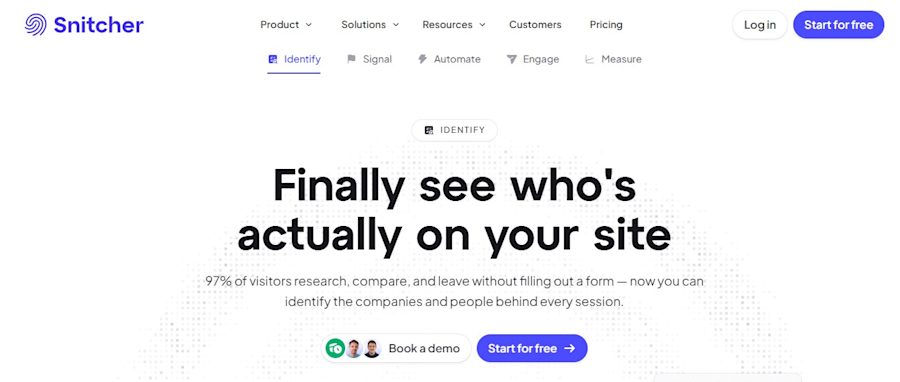
Snitcher identifies the companies visiting your website and enriches them with firmographic and intent data, with a native Google Analytics 4 integration that most visitor-tracking tools lack. It positions itself as GDPR-focused, matching visitor IPs to company data and revealing individual contacts only when you choose to.
Best for: Lean teams wanting simple, GDPR-first visitor identification
Key features:
Company-level visitor identification with firmographic enrichment
Native GA4 integration, plus CRM sync for HubSpot, Salesforce, and Pipedrive
Real-time intent signals with Slack and email alerts
Every feature on every plan, with a REST API and unlimited team members
Challenges:
Focuses on visitor identification rather than a full ABM or outbound suite
Smaller data and brand footprint than the enterprise platforms on this list
Snitcher is a strong fit for teams that want straightforward, GDPR-compliant visitor identification with transparent pricing. Plans start at €49/month (up to 50 identified companies per month) with a 14-day free trial, scaling by volume.
9. Pearl Diver
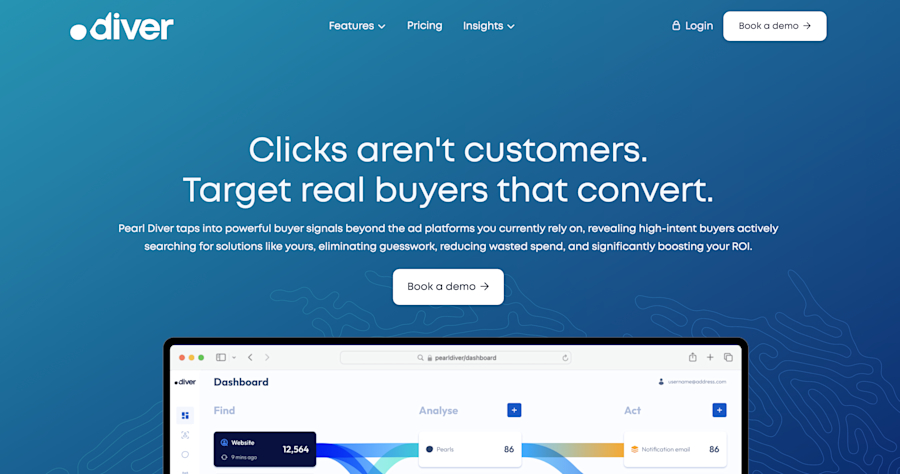
Pearl Diver provides analytics focused on anonymous visitor identification and segmentation, with a strong focus on the US market.
Best for: US-based teams needing segmentation
Key features:
Segmentation by visitor type and account profiles
Opportunity generation workflows
Real-time notifications
Zapier integration for automation
Challenges:
Strongest dataset is US-only, limited international coverage
Tiered pricing that has moved upmarket; entry plans are commonly cited from around $199/month, with agency tiers into the thousands (confirm the current rate, as published figures vary by source)
Fewer native integrations outside Zapier
Pearl Diver works well for US-focused teams needing segmentation, but its limited coverage makes it less appealing for global organisations.
10. Koala
Koala uses artificial intelligence to automate prospecting and account discovery, targeting scaling companies that want more automation.
Best for: Startups and scaling teams exploring AI
Key features:
AI-driven prospect discovery
Real-time intent detection
Automated account segmentation
Free plan for startups; paid plans from around $200/month (Starter)
Challenges:
Still a relatively young player, less proven in enterprise settings
Limited dataset compared to more established competitors
AI insights can sometimes lack transparency for end users
Koala shows promise with its AI-driven approach, but more established platforms often offer greater reliability and breadth.
Comparison Table: Albacross Alternatives
How to pick the right platform for your team
Many companies will start out by looking for a visitor tracking platform, focusing on the one with the most features. But picking the right platform should take into account many other factors. Ultimately, the best fit is the tool that most closely aligns with your revenue team’s goals, workflows, and growth stage. Think of it like choosing a running shoe: the flashiest model isn’t necessarily the right one for you. The best fit depends on how (and where) you plan to run.
1. Start by asking: what do we need this tool to achieve? For some teams, the priority might be lead generation and pipeline feeding. For others, it’s about deep visitor behaviour analysis or supporting an account-based marketing program. Team size, industry, and even regional coverage should all shape your decision.
2. Once you’ve defined those needs, test how well each platform actually performs on your own website traffic. A tool’s claims about accuracy and intent signals only matter if they hold up against your real visitors.
3. Don’t forget the “hidden costs”. Subscription fees are only part of the equation; you also need to factor in setup, training, support, and integration expenses. The best platform should slot into your existing tech stack (think Salesforce, HubSpot, Marketo), not force you to reinvent it.
4. Finally, set clear adoption goals by defining success up front with measurable KPIs such as visitor identification rates, qualified leads generated, or pipeline influence. Having clear benchmarks ensures you’re not just adding another dashboard to check, but a real growth driver for your team.
Leadfeeder in the B2B Intent Data Tools Landscape
Where many visitor tracking tools stop at “who visited your site and what they looked at”, Leadfeeder goes further. It doesn’t just surface anonymous traffic, and it connects the dots between website activity, buying intent, and account engagement. That means you don’t just know who was on your site, but also why they were there and how ready they are to buy.
In a Leadfeeder vs Albacross comparison, this is where Leadfeeder differentiates itself from other visitor-tracking solutions: it’s a pipeline generation platform. By linking visitor data with ideal customer profile (ICP) matching, intent signals, and multi-channel engagement, Leadfeeder reduces the manual work that often slows revenue teams down. Instead of piecing together data from disconnected tools, Sales, Marketing, and RevOps can see a unified picture of account behaviour in real time.
Integration is another strength. Leadfeeder connects seamlessly with CRMs and marketing automation platforms, so insights don’t stay locked in another dashboard, and they flow directly into the systems your teams already use. On top of that, built-in compliance and privacy features give peace of mind in markets with strict data laws (a must-have for EU-focused companies).
From prioritisation filters to automated alerts, Leadfeeder ensures teams focus on the accounts that matter most, meaning you spend less time chasing ghosts and more time building a quality pipeline.
Key Takeaways for Choosing Albacross Web Visitor Tracking Alternatives
Picking the right platform comes down to a few essentials:
Data accuracy: Are the visitors being correctly matched to the right companies?
Intent signals: Can the platform separate casual browsers from serious buyers?
Integration capabilities: Does it play nicely with your CRM and marketing stack?
Privacy compliance: Does it meet the regulatory standards of your target markets?
Cost scalability: Will it still make sense as your team and traffic grow?
Onboarding and support: Is there help available to get your team up and running quickly?
Get these right, and visitor tracking stops being just another tool in your MarTech stack. It becomes a foundation for scalable, insight-driven sales and marketing growth. Accurate data fuels better prioritisation, intent signals sharpen your targeting, and integrations connect everything back to the systems that power your pipeline.
If you’re still weighing options, don’t hesitate to trial multiple platforms. Compare how well they identify your real traffic, and how smoothly they fit into your workflows. But above all, focus on tools that help all parts of your revenue organisation (Sales, Marketing, and RevOps) work together to generate a pipeline more effectively.
FAQs about Albacross competitors and alternatives
How long does it take to switch from Albacross to another visitor tracking platform?
Switching from Albacross to a competitor usually takes between a few days and one or two weeks. Most providers handle setup, data migration, and training during this period. The exact timeline depends on your tech stack complexity and how many integrations (like CRM or marketing automation systems) need to be connected.
Are Albacross alternatives and other visitor tracking tools GDPR compliant?
Most leading website visitor tracking tools include GDPR and privacy compliance features, such as cookie consent management and data processing agreements. However, compliance isn’t automatic; each business should confirm that their chosen platform meets specific legal and regional requirements. Platforms like Leadfeeder are designed with GDPR at their core, so a European solution is often worth considering if you cover European markets.
Albacross vs Leadfeeder: which is the best option for small businesses?
For small teams, Leadfeeder is often the strongest choice. Its free plan makes it accessible, while features like Google Analytics integration and customizable lead lists help SMBs get started quickly.
How much website traffic do you need to test a visitor tracking platform effectively?
To get accurate results when comparing Albacross alternatives, you’ll want to run a test with at least one month of website traffic. This ensures visitor identification rates are meaningful. If your site has higher traffic volumes, you’ll gain even clearer insights into accuracy and data quality across different platforms.
Do Albacross alternatives integrate with Google Analytics and other analytics tools?
Yes. Most modern visitor tracking platforms integrate with Google Analytics and other analytics solutions. This lets you combine anonymous visitor identification data with your existing traffic reports, giving your team a more complete picture of how prospects are engaging with your site.
Which Albacross competitor works best for enterprise sales teams?
Enterprise sales teams often look to platforms like ZoomInfo Sales or 6sense for their extensive databases and predictive analytics. However, Leadfeeder has become increasingly popular at the enterprise level thanks to its ability to connect visitor data with broader Leadfeeder sales intelligence. This makes it not just a visitor tracking tool but part of a complete revenue platform.
Disclosure: This comparison was researched and published by Leadfeeder, a product of Dealfront Group GmbH. As a competitor in this space, we have a commercial interest in this topic and have aimed to present an objective, balanced analysis. All third party competitor pricing, features, and claims reflect publicly available information at the time of writing. Product details change frequently. We encourage you to confirm current information directly with each provider before making a purchasing decision. Trademarks and brand names referenced in this article belong to their respective owners and are used solely for identification.