Is cold calling dying? Are regulations like GDPR overly complicating outreach tactics? Or, is consumer cynicism to blame?
Regardless of what exactly has caused this change, it’s clear that succeeding in sales now requires better B2B sales prospecting techniques.
In this article, we will discuss exactly what B2B sales prospecting is, why using the right techniques is so important, and which B2B prospecting techniques will give you the greatest chance of success.
Note: Want a better way to find qualified prospects? Try Leadfeeder, the B2B sales prospecting tool that shows you which companies visit your website—even if they don't fill out a form. Sign up for a free 14-day trial.
What is B2B prospecting?
In short, B2B prospecting is the process of identifying potential customers for your business. It is a crucial part of your sales funnel, helping you acquire more customers and generate more revenue.
The process involves researching your potential prospects and reaching out to form relationships. This allows you to nurture prospects into clients.
B2B prospecting can be done in two ways:
Inbound: This involves the marketing team providing the sales team with a list of prospects. The key elements of inbound prospecting are to engage, attract, and delight, meaning your content should resonate and build rapport with your audience to establish relationships.
Outbound: This direct strategy involves the sales team finding and selecting their own prospects using a range of prospecting techniques. The main aim of outbound prospecting is to generate interest in your product or service and drive sales.
What's the difference between sales prospects and leads?
The terms “prospects” and “leads” are often used interchangeably—but they aren't the same.
So, what's the difference?
Leads are contacts who have expressed potential interest in your business. For example, someone downloading a white paper about your industry would be a lead.
Prospects are contacts with specific characteristics who have expressed interest in your business.
The difference might seem slight, but it is crucial.
For example, a lead could be someone who has filled out a form to download a white paper on your site.
They've expressed some interest, but are they B2B? Are they the decision-makers? Are they an SMB or an enterprise company?
Prospects are a bit further down in the funnel. They have a vested interest in your offering, a challenge you can help solve, and are interested in contact beyond just signing up for an email list or following you on X (formerly Twitter).
Understanding the difference matters because the sales process differs for leads versus prospects.
Leads are just getting to know you, so the sales process can be somewhat automated.
Prospects, on the other hand, are closer to the bottom of the funnel. They know who you are and usually need a more hands-on approach.
What is the importance of B2B sales prospecting?
B2B prospecting is an important part of your sales process because it helps you identify new growth opportunities. But the benefits don’t end there.
Prospecting tactics can help you foster better client relationships and lead to long-term success for your business.
Some of the other key reasons to use B2B prospecting methods include:
Identifying potential customers (including key decision-makers): These businesses may genuinely need or be interested in your product or service. This saves you time and money spent chasing poor-quality leads.
A better understanding of potential customer needs: Understanding your prospect’s wants, needs, and pain points can help you craft an offering they can’t refuse.
A new or improved sales pipeline: B2B prospecting strategies help you find a continuous stream of good-quality leads. This helps ensure enough potential clients to nurture throughout the sales process.
Getting started with sales prospecting
Getting started with B2B sales prospecting is a fairly straightforward process that involves setting goals and better understanding your customers so you can map their journey. Some of the best prospecting techniques include:
1. Create an ICP
Your ideal customer profile (ICP) is a fictitious representation of your ideal target company. It can help you identify the right prospects and tailor your communication to better engage leads.
To create an ICP, you’ll need to look at data related to your ideal client, such as:
The type of company that’s best suited to your product or service.
The firmographics, such as company size, industry, location, and revenue.
Who the key decision-makers in each business are (e.g., job titles and roles).
What the budget is for products or services like yours.
The client's pain points.
Their technological infrastructure (if relevant).
Once you’ve created an ICP, you can segment the data based on your requirements.
2. Calculate your TAM
Identifying your ICP will also allow you to calculate your TAM. Standing for total addressable market, TAM is the maximum potential revenue opportunity for a product.
Calculating the profit you would make if your product achieved a 100% market share can be very valuable for go-to-market strategies and for planning marketing campaigns.
Use Leadfeeder’s free TAM Calculator to quickly and easily complete your Total Addressable Market calculations using data from the most accurate B2B database in Europe.
3. Define buyer personas
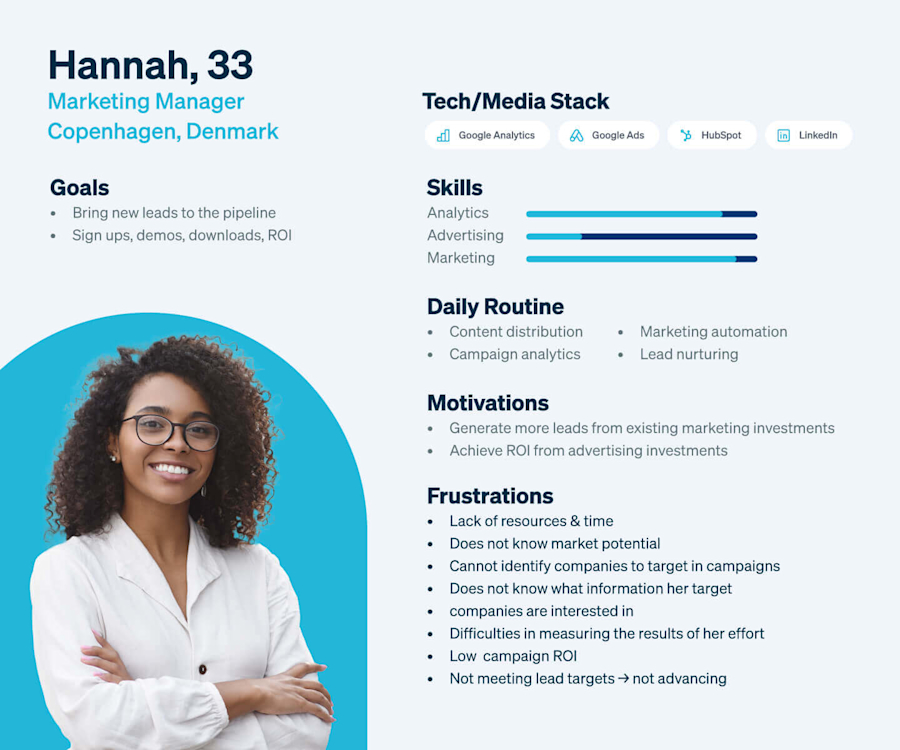
Defining a buyer persona can help you hone in on the traits and behaviors of individual people in your ICP framework and form better relationships with any contacts you make. To define a buyer persona, you’ll need to gather data such as:
Demographic information: This includes industry, business size, job title, age, and location, helping you understand the professionals you’ll need to engage.
Psychographic information: Understanding people’s goals, challenges, and fears can help you tailor your communication so it resonates better.
Behavioral attitudes: This tells you how people interact with your brand or similar brands, including their preferred communication channels, online habits, and decision-making processes.
Decision-making attributes: Here, you'll discover what drives decisions, what the client’s role is in the decision-making process, and any barriers that may pop up along the way.
A well-defined buyer persona can help you identify the right people to talk to in a business and tailor your content and offers to meet their needs.
4. Understand the buyer journey
Understanding the buyer’s journey is an integral part of prospecting B2B. In the B2B market, you deal with multiple decision-makers who are usually well-informed about your products or services.
This means a run-of-the-mill sales strategy won't necessarily cut it.
Once you understand who your ideal client is, you can map out your client’s journey to see where you fit in using website visitor tracking.
A B2B customer’s journey will usually include:
Product or service research, both online and offline.
Meeting with buying groups.
Consideration.
Final decision.
5. Set targets
The best way to keep your B2B prospecting on track is to set quantifiable targets.
By setting daily and monthly targets, you can easily measure success and make prospecting a continuous part of your sales strategy.
Here are some examples of B2B prospecting metrics you could track as part of your sales goals:
The number of meetings booked with prospects each month
The number of LinkedIn connection requests that are approved
The number of calls that your reps make each day
The revenue numbers you want to achieve each month
Inbound vs. outbound prospecting
As briefly mentioned earlier, B2B prospecting can be either inbound or outbound.
Inbound prospecting involves the sales team connecting with leads who have already expressed interest in your company. These could be people who subscribe to your newsletter or have visited your website.
Inbound prospecting can be a more cost-effective way of identifying potential customers, as you’ll already have access to useful data, and there’s a chance these leads are already interested in what you have to offer.
On the other hand, outbound prospecting involves your sales reps sourcing new prospects and building relationships from scratch. While there may be a bit more work involved, outbound prospecting is vital in bringing in more prospects.
The top ten B2B sales prospecting techniques you need to be using
Sales prospecting techniques are methods that salespeople use to reach potential leads.
This can include strategies like cold calling, social selling, conference networking, making phone calls, or even buying a sales lead list.
Figuring out the right sales prospecting technique is a challenge because the most effective prospecting techniques can vary by organization, industry, and even the personality of the lead or salesperson.
So, what used to work might no longer work, and what might work now depends on various factors.
To help you out, we will explore the top sales prospecting techniques you should use.
1. Cold calling
Cold calling gets a bad rep, but getting a prospect on the phone can help your sales team bring that much-needed human touch into business-to-business prospecting.
The beauty of human contact is that your sales team can read the prospect's tone and gauge their reaction.
The salesperson can then amend their strategy to suit the individual, which can help build rapport and nurture the early stages of the relationship.
Another benefit of cold calling is that you can address queries, concerns, and barriers to a sale on the spot. This can help speed up the sales process compared to other communication methods, such as emails and adverts.
"Cold calling thrives because it’s the road less travelled. While C-suite executives are inundated with emails, they receive far fewer calls because salespeople will only ring at the level they believe they are worth. By choosing to call, sales professionals stand out, creating direct connections that emails often miss. Sales is always about going against the grain rather than doing what everyone else is doing."
Zac Thompson, Founding Director at We Have a Meeting
2. Email prospecting
Email prospecting is useful because it allows you to present your information aesthetically. It’s a more visual approach than a phone call.
Emails can provide the prospect with the key information needed to make a purchasing decision, and they can also be forwarded to the main decision-maker.
Email personalization is a great way to engage recipients and encourage further interaction. You can also improve the effectiveness of an email by using short, easy-to-read paragraphs, clear language, and a strong call to action.
You can use cold emailing templates to ensure your sales team consistently uses a script that works.
3. Social selling
You need to go where your prospects spend their time—and that place is social media.
Social selling is a sales prospecting strategy in which sales reps use social media to build relationships with decision-makers and target accounts.
Social selling doesn’t require the entire sales process to be over social media—and it doesn’t have to happen on LinkedIn alone.
There are two main types of social selling:
Broad authority-building so prospects and followers view you as an expert in your industry.
Targeted sales prospecting and nurturing to individual decision-makers and target accounts.
The different types of social selling can be deployed separately or together—the choice is yours.
For example, you might use LinkedIn to build a personal brand and then leverage it to connect with targeted accounts as part of an account-based marketing strategy.
Social selling is effective because it leverages a medium where people are more comfortable communicating and building relationships.
You won't find that kind of openness over the phone.
By connecting and interacting via social media first, prospects are more willing to participate in sales conversations later in the sales process.
Essentially, social selling warms up a cold prospect.
4. In-person events
In-person events give B2B salespeople the chance to network and build relationships with prospects in a way that can’t be mirrored remotely.
In-person events include:
Industry events (award ceremonies, exhibitions, etc.)
Roadshows
Business networking events
Attending these events helps you bring a human side to your brand. It allows your sales team to step out of the ‘sales’ mode and get to know individuals in the industry, their hobbies, pet peeves, and so on.
The aim is to connect with prospects more deeply to establish trust. This involves listening to their struggles and identifying their pain points rather than giving them the “hard sell.”
“In a world overflowing with virtual interactions, F2F meetings have taken on a whole new meaning. They are instrumental when it comes to building trust and making relationships stronger. You just can’t beat the value of a handshake, something you simply can't replicate while hiding behind an avatar.”
Dipak Vadera, Director of Community and Ecosystem Marketing at Leadfeeder
5. Sales cadences
Sales cadences are scheduled and sequenced interactions with prospects. The sequence can include emails, calls, and social media posts designed to build customer relationships and address queries.
The purpose of a sales cadence is to streamline communication and ensure your sales team maintains a consistent level of engagement.
If you have created your ICP and customer persona, you can determine the best communication channels for your audience.
6. Content marketing
Using content marketing helps put your brand in front of potential customers to generate interest. It’s one of those sales prospecting methods that requires great audience knowledge.
Having an accurate buyer persona will help you create content that’s more likely to resonate with your target prospects because you can address their pain points and use media that’s more likely to impact them.
Content marketing for B2B prospects works best when it aligns with your prospecting goals. You should create content across various channels, such as videos, blog posts, white papers, and case studies.
You can then promote the content through targeted ads, social media posts, and emails.
7. Free trials
Everyone loves a freebie. Right?
Free trials are an effective way to put your product in the hands of potential buyers without resorting to pushy sales tactics.
Understanding your customer well and having confidence that your product meets their needs can be an incredibly powerful way of converting prospects into leads.
From the customer’s perspective, a free trial reduces the risk of making a bad purchasing decision, and from a sales perspective, it gives your sales team the chance to demonstrate the product and how it can solve a customer's problem.
Done well, it can help build relationships and even increase word-of-mouth referrals.
8. Referrals
Think about the last time you were looking for a new restaurant for dinner or a new television show to veg out to.
Did you Google "best restaurant near me" or did you ask a friend?
Most of us rely on trusted people for recommendations, and B2B sales is no different.
Rather than casting a wide net, referrals give you access to pre-qualified prospects who are already inclined to trust you—and be interested in what you offer.
So, how do you get more referrals? Here are two tips:
Ask new clients in the first few weeks: They’re likely to be still excited about your product/service and are better able to explain why it's so awesome.
Use automation: You've got a lot on your plate, and referrals might be low on your list of priorities. Create an automated email sequence using email sequence software or a platform that sends handwritten notes, so you never forget to ask for those referrals.
According to Nielsen, recommendations from friends remain the most trusted form of advertising. So, make sure you’re leveraging the power of current customers to bring in new prospects.
9. Paid advertising
Paid advertising has been a staple for lead generation for a long time, and most businesses use it because it still works.
The benefit of paid advertising is that it allows you to target your audience with ads tailored to a specific niche.
This could be ads targeted to people with a specific job title or to companies in a specific industry, so your ads will land in front of the right sets of eyes.
By creating effective ads that connect with your audience through their wants, needs, and pain points, you can increase brand awareness and boost conversions.
10. Visitor identification software
Given the additional time investment required by effective sales prospecting, ensuring you're targeting the right prospects is important.
Visitor identification tools provide access to the data you need to show value and deliver knock-out pitches.
A visitor identification tool (like Leadfeeder) shows you data like:
Companies that have visited your website.
How many people from a given company have visited your site?
The pages they looked at.
How long did they spend on your site?
That’s information that can help ensure:
You’re providing information and content that’s genuinely valuable to prospects.
You have inside knowledge about what matters to them.
You can time and tailor your pitch to yield better results.
Rather than using a scatter-shot approach, you can leverage visitor behavior data to create personalized, detailed pitches.
For example, you might see three people who work at Microsoft who’ve visited your site and read two related blog posts. That data tells you what they’re interested in and what they’re interested in.
Improve B2B prospecting for sales with Leadfeeder
While the B2B prospecting techniques that used to be your go-to may no longer be the most effective, there are still plenty of techniques out there that will lead to sales success.
However, as the efficacy of these techniques varies from industry to industry, you must choose the prospecting methods that will work best for your industry and your individual business.
You should also ensure your sales tech stack is up to date, as B2B prospecting tools are designed to make the process easier and more effective.
Take Leadfeeder. Our sales prospecting tool can help you identify visitors to your site and alert you to who may be interested in what you have to offer.
Our tool can also monitor visitors' actions on your site, revealing which aspects of your marketing strategy are generating the best leads.
Note: Eager for more leads? Start Leadfeeder’s 14-day free trial to see who’s been clicking around your site. Warm leads for the win.

Team Lead Growth AM/Sales Team @ Leadfeeder
Thijs Schutyser is Sales Manager at Leadfeeder with more than a decade of experience in B2B sales and pipeline generation. He has worked across account executive and leadership roles, helping companies turn website visitor data into qualified sales opportunities.
Having delivered hundreds of product demos and worked directly with sales teams across Europe, Thijs brings firsthand experience in modern sales prospecting and buyer engagement. His experience using visitor insights and intent signals to prioritize outreach informs his perspective on building a predictable pipeline and improving sales prospecting strategies.