
60-Second Summary
Leadfeeder moved from single-person generalists to a dedicated, specialized B2B marketing team to drive scalable growth. The piece outlines team structure, essential professional and personal skills, role-specific KPIs, and practical hiring strategies for building a high-performing remote marketing organization.
Key takeaway: Build specialized roles (growth, product, content, web/design) rather than relying on one-person generalists—this improves alignment, accountability, and measurable results using role-specific KPIs.
Standout strategies & tactics: Split teams by funnel function, hire self-motivated remote hires, outsource cost-effectively (freelancers/agencies), and track channel- and role-specific metrics (e.g., demos, trials, adoption).
Real-world lessons & frameworks: Match team structure to go-to-market, company size, and budget; validate strategies before hiring specialists; use clear hiring steps (justify role, clarify duties, test assignment, fast onboarding); and measure with OKRs and role KPIs.
Leadership & team health: The Head of Marketing/CMO must align marketing with sales and stakeholders, remove roadblocks, hire for cultural fit, and enable processes that let a remote, self-motivated team execute at a high level.
Startups, in particular, often rely on a single person to handle multiple roles. While this gets the job done, it is far from optimal for driving growth and results.
At Leadfeeder, we have assembled a dedicated marketing team that covers growth marketing, product marketing, content, SEO, paid search, social media, and communications. Each member has a clear role and specialized skills to deliver results.
If you are leading a B2B marketing team, it helps to understand not only the structure but also the key skill sets required for each role. In this article, I will break down Leadfeeder’s marketing team structure, highlight essential skills and roles, share the KPIs we track, and explain the hiring strategies we use to build a high-performing B2B marketing team.
Skill sets of a marketing team
For me, there are two groups of skills critical for building a marketing team: professional and personal. Why? Employees can't do their job well without professional abilities, but they also can’t work effectively in a team without decent soft skills.
Professional skills include strategic planning, data analysis, content creation, and social marketing. I won't get into the details right now — there’s a whole section devoted to different roles requiring these skills.
The personal skills I find essential are creativity, teamwork, adaptability, critical thinking, and organization. Creativity prompts thinking outside the box and finding unusual solutions. Adaptability helps to quickly adjust the strategy to the target market's needs. Critical thinking is what allows strategists to hand-pick essentials from tons of information.
Still, none of this works if your team members don't have organizational skills, shared values, and the ability to work in a team.
They are working in one team toward the same goal, but this difference in strategy is counterproductive. That's why each team member must understand the specifics of the others' work to help them do their jobs effectively and achieve the team's goals more effectively. They need to be aligned in their goals.
B2B marketing team structure
Now, let’s get back to the structure. One thing I wanted to point out is that there’s no one-size-fits-all structure. You must adapt your team to your go-to-market strategy, company size, and work style.
Company size
Leadfeeder is a growing SaaS company focused on inbound growth at scale. We started small but now have a marketing team divided into subgroups that cover the entire marketing funnel.
They include demand capture, demand growth, product adoption, website, and creative teams. Each area consists of two-to-five roles, including lead managers, and we outsource some services to stay flexible, focused, and fit the budget.
This structure perfectly matches our needs. But if you’re a large B2B company that releases or updates products frequently, you may need more roles within the same marketing areas.
For example, if you can hire separate writers for email marketing, blogs, and social media posts — do it. This way, one person wouldn’t need to juggle different types of content for several products on their own.
Long-distance relationship
I’d also like to mention the specifics of remote work, as common organizational issues intensify with greater distance and less control. Do you want to know how Leadfeeder solves the issues of remote work? We hire self-motivated people.
I know, easier said than done. But investing time and effort in hand-picking the right people always pays off.
Self-motivated people won’t do their job half-heartedly, and managers don’t need to micro-manage them.
Naturally, support team-building activities, managerial guidance, and KPIs greatly motivate your remote team. Still, only the self-motivation to do a great job and benefit the company can make remote employees skip their afternoon siesta.
Additionally, using tools and defining processes that support asynchronous work is critical to success in a remote work environment.
Budgeting
Of course, the budget greatly influences your team structure. If you manage a startup with limited funding, you likely wouldn’t hire a team of twenty just for marketing.
For small companies trying multiple strategies and discovering what works, a marketing generalist could be a good choice. For a company that already has one or two strategies that work well for them, having specialists to grow and optimize these is a great start.
In addition to building your in-house team, you can save costs by outsourcing certain tasks. For example:
Hire freelancers for SEO tasks, video content, or social media management.
Use platforms like Upwork for illustrations or graphics instead of hiring a full-time designer.
This approach allows you to cover essential marketing functions without overloading your budget.
Things get more complicated if you only have the budget for one role. This literally means you need to find a Swiss Army knife specialist who understands all aspects of digital marketing and their place in the marketing funnel.
Naturally, this person can’t do the work for the whole team, no matter how much you want them to. So just focus on hiring a marketing specialist who can analyze your data, design strategies, and assign tasks to freelancers.
Remember: the one-person structure is only a band-aid solution. And is it even a structure then? Once you want to grow, you’ll need a team with many roles focused on different marketing areas. Let’s talk about it.
Marketing roles broken down
Leadfeeder has a team of 12 marketers split into four areas that align with our acquisition funnel:
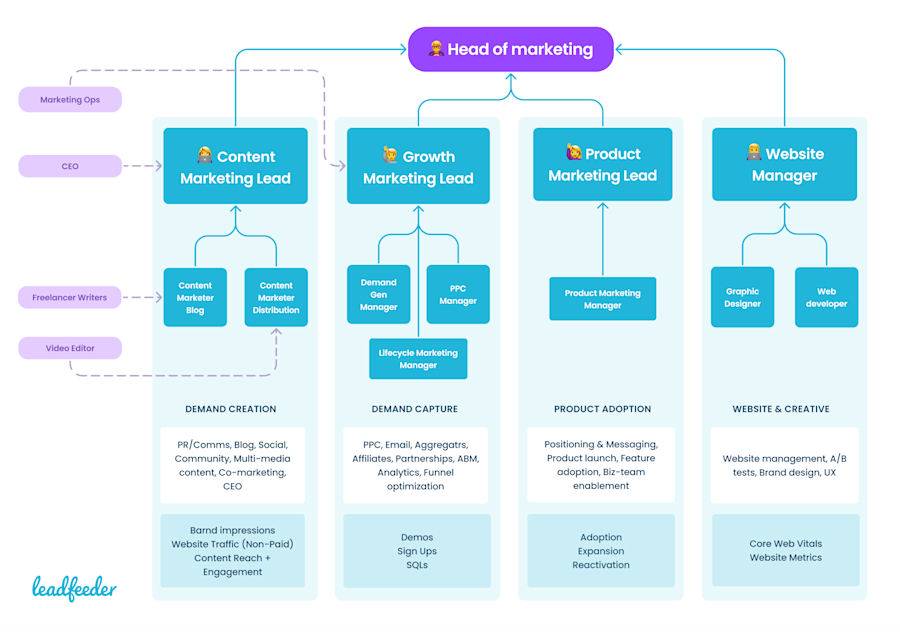
Here are each area's primary responsibilities and roles.
Growth marketing
Growth marketing is about improving engagement and conversion metrics throughout the marketing funnel. This means that growth marketing specialists capture demand in-market where customers make buying decisions. For example, we use pay-per-click ads, partnerships, and our website.
To reach this goal, the growth marketing team should:
Manage paid search and social acquisition channels
Optimize email campaigns
Create referral programs
Find partnership opportunities
Test the impact of strategy or tactic marketing updates on the marketing funnel
Update creative copy
Create reports for stakeholders
Our team consists of roles with a different focus to cover all areas and channels. We have a demand generation manager, a PPC manager, and a lifecycle marketing manager. But you can hire fewer or more people to cover these responsibilities, depending on your budget and goals.
Product marketing
Product marketing works to ensure the successful launch and adoption of new products. I would say this team works ahead of other departments because they’re responsible for:
Researching the market to ensure features, naming, and packaging of the product fit customers' needs
Creating messaging and controlling its consistency throughout all channels and content types
Analyzing customers' responses to the products
Adjusting and improving strategy and tactics
Thanks to product marketers ensuring consistent product messaging, customers won't have unreasonable expectations and are more likely to adopt the product after a free trial.
Content marketing
Content marketing specialists create and distribute engaging and informative content across our channels. This way, they generate leads and product demand in the target audience.
Depending on the roles, writers, distribution managers, and podcast or video editors have different responsibilities. Still, they cover tasks related to content creation, including:
Developing texts or videos for our blog, landing pages, social media, case studies, guides, webinars, etc.
Writing email marketing content
Promoting content with SEO optimization
Leadfeeder uses an in-house content team and outsourced professionals to keep up with the pace without losing quality. We currently have skilled content managers who handle on-page SEO and use technical SEO services from outside agencies.
Web and design
Web designers and developers care about how our brand and products look online. They’re basically responsible for three things:
Creating visuals such as logos, diagrams, infographics, packaging, or product designs
Making sure our website and products work error-free and provide users with the best user experience
Owning the look and feel of the brand to ensure consistency across all brand assets
Ultimately, you can’t have one without the other: how your website or product looks is as important as how user-friendly it is.
Head of Marketing or Chief Marketing Officer (CMO)
Above all these roles stands the head of marketing, who has the most expertise to guide the team and manage the company's entire marketing strategy. Their primary responsibilities are:
Overseeing all outbound and inbound marketing activities
Developing the company's brand identity and brand awareness in consultation with shareholders
Ensuring the company’s marketing goals are transparent and clear for better alignment with the sales team, the legal department, and top managers
Managing the marketing budget
Listening to employees’ initiatives to grow the marketing team and achieve better results
Plan for both long-term and short-term hiring of quality people who fit in with the team
Enable the marketing team to execute at a high level by improving processes, removing roadblocks, etc.
Monitoring and reviewing reports on objectives and key results (OKRs) across all marketing areas
And speaking of OKRs, let’s look at my favorite ways of measuring a marketing team's success.
Essential marketing KPIs
KPIs are every manager’s favorite subject, as they’re basically the quantitative equivalent of your marketing success. Here’s a brief overview of the metrics Leadfeeder’s marketing team targets.
The content marketing team checks:
Traffic: the number of people visiting your website on a monthly/quarterly basis
Brand search impressions: the number of people searching for the Leadfeeder brand name in Google on a monthly/quarterly basis
Social reach: the number of unique users we reached on Facebook, Instagram, Twitter, or LinkedIn
The growth marketing team tracks:
Demos: the number of ICP fit leads who booked a demo
Trials: the number of ICP fit leads who started a free trial of the product
The product marketing team reports on:
Adoption: the number of users who adopt key features of the product during their onboarding process
Reactivation: the number of churned or free users who reactivate their subscription
Upselling/cross-selling: the revenue generated from new features and product launches
By checking all these metrics, we achieve two goals. First, our specialists know the objectives that come with their responsibilities and strive to achieve them.
Secondly, we can closely monitor the performance of our sales funnel and continually optimize it to drive growth, rather than relying on a single tactic, such as traffic growth.
As you can see, your marketing team can only reach good results if you hire the most suitable person for each role. By the way, would you like tips on that?
The best hiring strategies
Determining a skill gap in your team is only half the battle. So, choosing the right hiring strategies is one of the most critical things a marketing leader needs to get right. Here are some that helped Leadfeeder, a B2B SaaS company, build a perfect marketing structure.
Explain the need for a position
First of all, explain why you need to hire a person for this role. Explain it to yourself, the stakeholders, and — no less important! — the candidates.
Perhaps you've validated a new marketing campaign and need a specialist to handle it. Make it clear why, without this person, you’ll lose more than the value they’ll bring to the table. Be specific, confident, and use numbers where possible to streamline decision-making and ensure stakeholders won't protest extra staff costs.
When in doubt, outsource
If you still can't fully justify hiring a full-time employee, try hiring a contractor first. Hire an agency or freelancer to do the job (at least temporarily) and prove the need for more resources without the hiring overhead.
You'll save money and time while defining role requirements more clearly.
Clarify the details
Now that you know what position you need, clearly define what you expect. Inconsistency between job title and duties is a common problem, especially for account managers, content writers, and marketers.
Next, establish a transparent interview process and selection criteria. And if you have no problem with test assignments, I’d definitely recommend them too. At Leadfeeder, we give candidates a small assignment as part of the hiring process that helps us understand how quickly the person works and thinks.
Set up a quick and transparent onboarding process
Finally, a well-structured onboarding process (particularly in a remote-first company) is critical to get the new hire up and running ASAP. Don’t leave the person hanging! Outline the next steps for them, discuss the details in person, and introduce them to the team before assigning any tasks.
After that, it’s your job to make this new employee feel like a part of your marketing team. How about a tiny meet-and-greet session? Let the person in on an inside joke, show them some pictures of your cat(s?), and ask them about their favorite cake — you get the idea.
The skinny on marketing team structures
Building a powerful marketing team is possible if you know your needs and think twice before allocating resources. Even when you have enough money to hire a full-time team for your marketing operations (growth, product, content marketing, plus web developers and designers), choose every role carefully. And if something can be outsourced, do it.
Just remember that self-motivated people are the diamonds you should be digging for, and once you find them, create a working environment they’ll love.

CMO
Jillian Als is Chief Marketing Officer at Leadfeeder and a B2B SaaS marketing executive with nearly two decades of experience leading global go-to-market teams. She specializes in revenue-driven marketing strategy, demand generation, and aligning marketing and sales organizations.
Throughout her career, Jillian has helped SaaS companies scale marketing-sourced revenue and build high-performing marketing teams across international markets. Her leadership experience shapes her perspective on marketing strategy, attribution, and the systems modern revenue teams use to drive sustainable growth.