60-Second Summary
Automating demand generation streamlines how you attract, qualify, and convert prospects while saving time and resources. This guide compares 18 B2B tools and highlights using Leadfeeder to identify company visitors and measure campaign impact.
Key takeaways: Invest in automation, integration, and analytics—choose tools that match your workflows and scale with your business; Leadfeeder is strong at identifying company visitors and enabling account-focused outreach.
Standout strategies and tactics: Combine ABM targeting (Leadfeeder, Demandbase), CRM + automation (Pipedrive, HubSpot, Pardot), landing-page testing (Unbounce, VWO), and connectors (Zapier) to capture, qualify, and route leads rapidly.
Real-world lessons and frameworks: Prioritize value, ease-of-use, features, scalability, and analytics; run trials, iterate on data (Hotjar, Semrush), and stitch best-of-breed tools together for full-funnel coverage.
Practical tip: Use Leadfeeder to map website behavior to target accounts, then deploy programmatic ads or LinkedIn outreach and measure impact with integrated analytics to continually optimize campaigns.
*This summary was created with AI assistance, using our original content.
By automating the processes involved in attracting prospective leads to your product, you can save time, effort, and resources that would otherwise be spent on manual tasks.
However, if you are unsure of how to choose the right demand generation tool to meet your business needs and drive interest in your products and services, you’ve come to the right place. Our list of the 18 best demand generation tools will help you streamline your lead generation strategy and transform qualified leads into loyal customers.
We’ll also reveal our top tips for using Leadfeeder to discover which companies are visiting your website and track the impact of your demand generation strategies.
Sign up to Leadfeeder today to try it for yourself.
What is Demand Generation?
Demand generation is the process of generating interest in your brand and raising awareness of your product or service. It’s a type of inbound marketing that covers the top of the sales funnel, engaging potential customers and bringing them into the buying process.While demand generation can overlap with lead generation, it is typically higher up the sales funnel. Lead generation occurs once prospects have become aware of your product through demand generation and registered an interest.
Demand generation is all about reaching people who haven’t yet heard of your business. As the process unfolds, you’ll learn about their needs and pain points, helping you tailor your marketing messaging and enhance your product offering. These insights pave the way for lead generation and are valuable for the whole customer journey.
As George Coudounaris of The B2B Playbook puts it, that’s not a small audience you’re ignoring: “The 95-5 rule tells us that only 5% of your target companies are in market, ready to buy right now... 80 to 90% will choose a vendor they've already heard of. So if they haven't heard of your brand, there's actually a one in a hundred chance that they will pick you.” - George Coudounaris, Co-host, The B2B Playbook
By raising awareness and creating trust in your brand before a buying trigger exists, you’ll be able to build relationships, retain loyal customers, and reduce future marketing costs.
18 Must-Have B2B Demand Generation Tools
Disclaimer: This comparison is for guidance purposes only and has been provided in good faith and to the best of our knowledge using the information available at the date of publication. All ‘Trademarks’ are the property of their respective owners. We are not endorsed by, directly affiliated with, maintained, authorized, or sponsored by any trademark holder referenced herein.The following list includes something for everyone. You'll find a range of demand tools in it, from freebies for startups to more advanced software that meets the complex needs of enterprises.
1) Leadfeeder
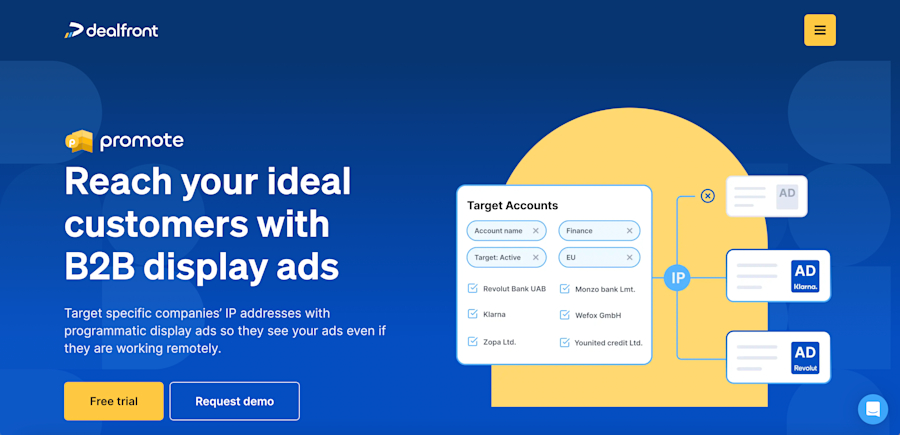
Leadfeeder specializes in B2B display advertising. It enables businesses to direct their marketing efforts at specific companies by targeting their IP addresses with programmatic display ads.
This feature allows for precise targeting in brand and product awareness campaigns, focusing on key account lists.
What sets Leadfeeder apart is its ability to go beyond traditional remarketing. This demand tool can automatically target open customer relationship management (CRM) deals.
Instead of targeting specific IP addresses, Leadfeeder offers wider reach. It enables for a company-wide targeting strategy.
Leadfeeder also has advanced analytics and reporting capabilities. These features allow businesses to monitor the effectiveness of their campaigns and understand their audience's behavior and preferences.
With its extensive reach, billions of available impressions, and the option to serve ads across various online locations, Leadfeeder enhances B2B marketing efforts. It helps businesses optimize their campaigns for better engagement and impact.
In addition to showing who’s engaging with your ads, Leadfeeder provides detailed company profiles and precise contact data to help you find and reach decision-makers. It also lets you search for other companies that fit within the same ICP, with more than 100 unique filters.
2) LinkedIn Sales Navigator
Price: Plans start at €78.67 per month and include a one-month free trial.
Best for: B2B sales teams looking to get the most out of their LinkedIn network.
LinkedIn Sales Navigator is a handy tool that helps you fully leverage LinkedIn's expansive data. It unlocks access to a broader network and provides insights into who has viewed your profile.
There are also advanced search functionalities. Users can reach out via InMail and efficiently prioritize and qualify leads within their sales funnel.
For higher-tier plans, Sales Navigator offers an expanded suite of tools. These include:
Enhanced capabilities for tracking engagement on LinkedIn
Detailed reports
Buyer interest alerts
Seamless integration with existing CRM systems
As an integral part of LinkedIn, Sales Navigator offers a familiar, easy-to-use interface. It eliminates the need for training and allows users to leverage the tool's capabilities right away.
3) Chili Piper
Price: Plans are on a per month, per-user basis and start at $25 and go up to $35.
Best for: Any company that wants to start automating their process to save some time.
Providing a range of automated processes, Chili Piper will help you to streamline customer interactions and enhance your sales team’s productivity.
Their platform automates the process of scheduling meetings, routing leads to the right sales reps, and facilitating seamless handoffs between teams, reducing delays and manual effort. It integrates with tools like Salesforce, HubSpot, and Google Calendar, ensuring all meeting data is logged and accessible while providing insights to optimize sales workflows.
4) Pipedrive
Price: Plans start at $9.90 per user per month for the Essential package and up to $59.90 per user per month for the Enterprise package.
Best for: Sales teams looking to power demand generation with a comprehensive CRM tool.
Pipedrive is a CRM designed for and by sales teams. It integrates with various tools most sales teams use, making it a powerful choice for sales and marketing automation.
Pipedrive does a lot, making it hard to cover all its features in a short blurb. So, we’ll just give you a brief overview of a few things it can do.
It's a CRM that serves as an account management tool, storing all information in one place. You can see leads and deals, track calls and emails, and sync across multiple platforms so everyone is always on the same page.
5) Zapier
Price: Free for basic features. Paid plans start at $19.99 per month when paid annually.
Best for: Anyone who wants to automate their demand generation process.
Zapier is a well-known tool that connects apps and helps automate workflows. If you need to receive an email notification when a new lead contacts you or if you're looking to link your sales and email software, Zapier is a solid solution.
It offers 4,000 different applications and plays a pivotal role in maintaining the efficiency and effectiveness of your demand generation strategy.
Using Zapier, you can effortlessly track and engage high-quality leads, streamlining your marketing and sales processes for maximum productivity.
6) VWO
Price: Standard package starts at £341 per month, billed annually. It also offers a Pro and Enterprise package for £784 and £1,372 per month, respectively.
Best for: Companies that want to experiment with different web page versions and identify the most effective designs and content.
VWO (Visual Website Optimizer) is a platform that helps businesses optimize their websites and digital experiences to improve conversions and user engagement. Providing tools for A/B testing, multivariate testing, split URL testing, and more.
Beyond testing, VWO offers features for heatmaps, session recordings, and user insights to track visitor behavior and understand how they interact with a website. This data enables businesses to make data-driven decisions, refine their user journeys, and ensure their websites align with customer needs and expectations.
VWO also integrates with other tools like Google Analytics and various CRM platforms, making it a flexible choice for businesses aiming to scale their optimization efforts.
7) HubSpot Marketing Hub
Price: Free basic tools. Paid plans start at $20 per month, billed annually, and go up to $3,600 per month.
Best for: Marketing teams who want to personalize their offers and messages to attract quality leads.
HubSpot Marketing Hub is marketing software that offers a wealth of insights for sales and marketing teams. These insights help you personalize your offering and attract leads ready to convert.
The tool also provides campaign automation, CRM, customizable email templates, A/B testing, social media integration, and more.
Overall, HubSpot Marketing Hub is an excellent option for large organizations with big budgets that need customizable solutions. But the costs can get steep for smaller companies looking to get the most out of their spending.
8) SEO Testing
Price: After a 14-day free trial, plans start at $40 per month for a single site and go up to $300 per month for 20 sites.
Best for: Teams who need to improve their SEO strategy to generate demand.
Search engine optimization (SEO) is vital for increasing your presence in organic searches and generating more demand from potential customers or clients. But “doing SEO” and actually driving demand are not the same thing, as Sam Dunning, Founder of Breaking B2B, points out:
“The biggest [mistake] is falling into what I call the traffic trap. [Marketers] look for a keyword that shows high traffic, chuck it into ChatGPT, pump out a quick article... A couple of months later, leadership asks, 'How many leads did it drive?' And the honest answer is: 'It didn't drive any leads. You just told me to do some SEO.'” - Sam Dunning, Founder, Breaking B2B
SEO Testing is built to close precisely that gap. By integrating with Google Search Console and pushing teams toward data-driven decisions, it keeps the focus where it belongs: on the signals that actually reflect demand.
Does it offer frills? Not really. But user reviews commend its value and its ability to do exactly what it's supposed to do.
9) Ortto (formerly Autopilot)
Price: Paid plans start at $509 per month when billed annually and range up to $1,699 per month.
Best for: Fast-growing SaaS brands that want to optimize their data in one place.
Ortto brings your customer data, messaging, and analytics together on a single platform. It connects to various platforms to do so, but also lets you input customer data directly.
You can also leverage Ortto's marketing automation to increase the productivity and efficiency of your marketing campaigns.
With Ortto, growth isn't a guessing game. You can eliminate pain points by bringing all your data together and placing your customer relationships at the forefront of everything you do.
This will allow you to create lasting connections, discover actionable insights to convert and engage leads, and expand your business.
10) Pardot
Price: Standard options are available for $1,250 per month, and Premium enterprise options for $15,000 per month.
Best for: Salesforce users with a robust marketing toolkit who want to boost marketing automation.
Pardot is a SaaS marketing automation platform owned by Salesforce. It offers email automation and targeted email campaigns for email marketing. It also provides lead management for B2B sales and marketing teams.
By automating common tasks, including tracking customer behavior and creating digital marketing campaigns, Pardot helps teams execute successful demand-generation tactics.
11) Wishpond
Price: You have to book a meeting to discuss pricing.
Best for: Companies looking for a marketing platform that doesn't specialize in one industry (i.e., B2B sales, SaaS, and similar) to plan demand generation strategies.
Wishpond wants its users to reach new customers and increase sales without breaking the bank. While it doesn't specify the pricing online, Wishpond says its platform is "affordable."
The platform boosts efficiency by providing an internal team of marketing experts to help plan a demand generation campaign.
12) Semrush
Price: Paid plans start at $129.95 per month.
Best for: All marketing teams — we're big fans of Semrush.
Semrush is a top-tier tool for content marketing, SEO, and other marketing efforts. It will guide you to make informed, strategic, data-driven decisions.
Semrush shows you how your content performs overall and compared to your competitors. It's great for social media managers as well since it also tracks analytics and ads. We regularly use Semrush in our larger marketing strategies.
13) RiteKit
Price: After a 7-day free trial, customizable plans start as low as $12 per month when billed annually.
Best for: Anyone who makes their living off of social media leads.
Even if you already have a favorite social media publishing platform, RiteKit can help. The platform offers various features to help you with the following:
Crafting and publishing content
Enhancing existing posts
Customizing call-to-action (CTA) links
Using relevant hashtags
There's also a Chrome extension to let you access your RiteKit package from anywhere on the web.
RiteKit can be your all-in-one social management platform. Its RiteForge package enables users to create and schedule posts at the best times, with the right hashtags and key metrics.
14) BuzzStream
Price: Paid plans start at $24 per month and range up to $999 per month for the most advanced features.
Best for: Companies in need of an end-to-end outreach platform to streamline digital PR and link-building efforts.
BuzzStream is an outreach platform that helps you build lists of qualified leads and send better emails at scale. Its Digital PR feature performs automatic prospecting of journalists and bloggers, and the Link Building feature automatically gathers website and social media metrics. There's also a Content Promotion feature to help you pitch content more effectively.
15) Hotjar
Price: Basic features are free. The Plus package costs $32 per month, and the Business features start at $80 per month.
Best for: Businesses that want to understand how users behave on their site.
Hotjar does a lot. Most notably, its heat map feature lets you see how users navigate around your website, including the spots they hover over but never click.
For example, did most of your website visitors look at the title of your latest white paper or webinar but not click? Ouch. Maybe that topic didn't resonate with your ideal customer.
But you must know these things in advance to prevent them in the future.
Using Hotjar's data, you can see which touchpoints users are getting stuck on or don't understand. The name of the game in marketing is improving customer experience, and Hotjar is a solid place to start.
16) Unbounce
Price: You can "start building for free," but paid plans start at $99 per month.
Best for: Businesses of all sizes that want to get more conversions from landing pages.
Unbounce is an AI-powered landing page builder. The tool offers smart features to help create stunning, high-performing marketing campaigns in minutes. Its landing pages have helped businesses turn billions of visitors into leads, sales, and signups.
What makes Unbounce unique is efficiency. The tool allows you to quickly and effortlessly build a landing page with AI.
17) Demandbase
Price: You’ll need to reach out to them for pricing.
Best for: Marketing, sales, and customer success teams that need go-to-market support.
Demandbase is a go-to-market platform that resolves and prevents fragmented B2B marketing. It eliminates account blindness, channel silos, data puddles, and manual processes, all of which can negatively impact your bottom line.
Demandbase does so by injecting account intelligence into every step of the buyer journey through advertising, account-based experience, and sales intelligence.
18) Clarityflow (formerly ZipMessage)
Price: Free 14-day trial. Paid plans start at $39 per month and go up to $149 per month for Premium features.
Best for: An all-in-one communication platform for anyone communicating with customers regularly.
Clarityflow is the iMessage of B2B. You can exchange video, audio, or text messages with clients all in one place. No more communicating between different apps and losing/missing client messages.
With Clarityflow, you get access to a range of communication features, including a mobile app, chat messaging, and transcription, to enhance your client's experience.
This puts your prospects and customers at the forefront of your business and helps drive more conversions and repeat businesses.
Demand Generation Tools Comparison
Tool | Category | Best For |
Leadfeeder | Advertising / ABM | Targeting specific B2B accounts |
LinkedIn Sales Navigator | Sales Intelligence | Prospecting on LinkedIn |
Chili Piper | Scheduling Automation | Faster lead routing & meetings |
Pipedrive | CRM | Managing pipelines and deals |
Zapier | Automation | Connecting tools & workflows |
VWO | CRO / Testing | Improving website conversions |
HubSpot Marketing Hub | Marketing Automation | All-in-one campaign management |
SEO Testing | SEO Optimization | Improving search performance |
Ortto | CDP / Automation | Centralizing customer data |
Pardot | Marketing Automation | Salesforce-based teams |
Wishpond | Lead Generation | Campaign support & execution |
Semrush | SEO / Content | Organic growth & insights |
RiteKit | Social Media | Content & hashtag optimization |
BuzzStream | Outreach / PR | Link building & partnerships |
Hotjar | Analytics | Understanding user behavior |
Unbounce | Landing Pages | Increasing conversions |
Demandbase | ABM Platform | Enterprise go-to-market |
Clarityflow | Communication | Managing client interactions |
What Does Your Demand Generation Software Need?
The right demand generation tool can help you increase brand awareness, contact relevant leads, and expand your market share.
Factors to consider when searching for the best demand generation software for your business include:
Value: Price matters, but even expensive tools can be worth the cost if they deliver results. The demand generation tool you choose should be fairly priced for the features and benefits on offer.
Ease-of-use: Look for a tool that doesn't require you to be a tech wizard to learn to use it. The product should have a user-friendly interface. It should also integrate well with other software you use.
Features: Your demand generation software should be functional and keep up with the latest trends and features to help you stay ahead of the curve.
Scalability: Whether you're starting out or growing fast, every tool you use must keep up with your business needs.
Analytics: You need to know whether your new demand generation strategy is working at every step. A tool that measures various forms of success can offer you the much-needed insights to make necessary adjustments.
See How Leadfeeder Can Help
When it comes to demand generation, gathering relevant customer data is important, but using it efficiently is essential.
That’s why automation and integration are vital features of the most up-to-date demand generation tools.
The best demand generation software should do more than collect data and track leads. They should also share that data across platforms, allowing your teams to access the detailed insights needed for demand-generation marketing strategies.
Leadfeeder is a demand gen tool that helps B2B organizations find and convert leads efficiently. Our platform identifies companies that visit your website, reveals their behavior, and helps you reach them before your competitors.
With Leadfeeder, you can also track the content on your website that visitors are engaging with. This is the best way to accurately assess and react to the success of your demand generation strategies.
Sign up for a free 14-day trial and discover your new leads today.
Demand Generation Tools FAQs
1. What are the main types of demand generation tools?
The main types of demand generation tools are:
Marketing automation tools, such as smart email marketing software or social media scheduling tools
Web analytics tools that reveal how your visitors found you and report on their onsite behavior
Content marketing tools incorporating SEO
Landing page building and optimization tools
CRM tools for managing contact details, tracking interactions, and segmenting leads
Digital PR and link-building tools
Communication tools for connecting with leads (and colleagues)
Specific lead-generation tools with lead scoring and qualification
2. Who uses demand generation solutions?
Any business that’s trying to build awareness can benefit from using demand gen solutions. Whether your business is new and you’re launching its first product or it’s an established company and you want to expand your customer base, demand generation solutions can turbocharge your efforts.
They’re especially important in B2B when you need to tell potential customers about the value of high-ticket items or intangible products like SaaS software.
What are the main steps in a demand generation strategy?
Set clear goals for your demand generation program.
Conduct research to identify market gaps and common pain points your offering can solve.
Define and segment your target audience, creating buyer personas and an
Create high-quality content that highlights the value of your product or service.
Launch email campaigns and programmatic ads to attract leads.
Optimize your landing pages and website, including SEO.
Use automation for tasks like contact management, lead scoring, and follow-ups.
Track your progress and improve where needed.
Disclosure: Leadfeeder is a product of Dealfront Group GmbH. This article includes references to third-party products and services. All third-party information reflects publicly available data at the time of writing and may have changed since publication. We recommend verifying details directly with each provider. Trademarks and brand names belong to their respective owners and are used here for identification purposes only.

CMO
Jillian Als is Chief Marketing Officer at Leadfeeder and a B2B SaaS marketing executive with nearly two decades of experience leading global go-to-market teams. She specializes in revenue-driven marketing strategy, demand generation, and aligning marketing and sales organizations.
Throughout her career, Jillian has helped SaaS companies scale marketing-sourced revenue and build high-performing marketing teams across international markets. Her leadership experience shapes her perspective on marketing strategy, attribution, and the systems modern revenue teams use to drive sustainable growth.